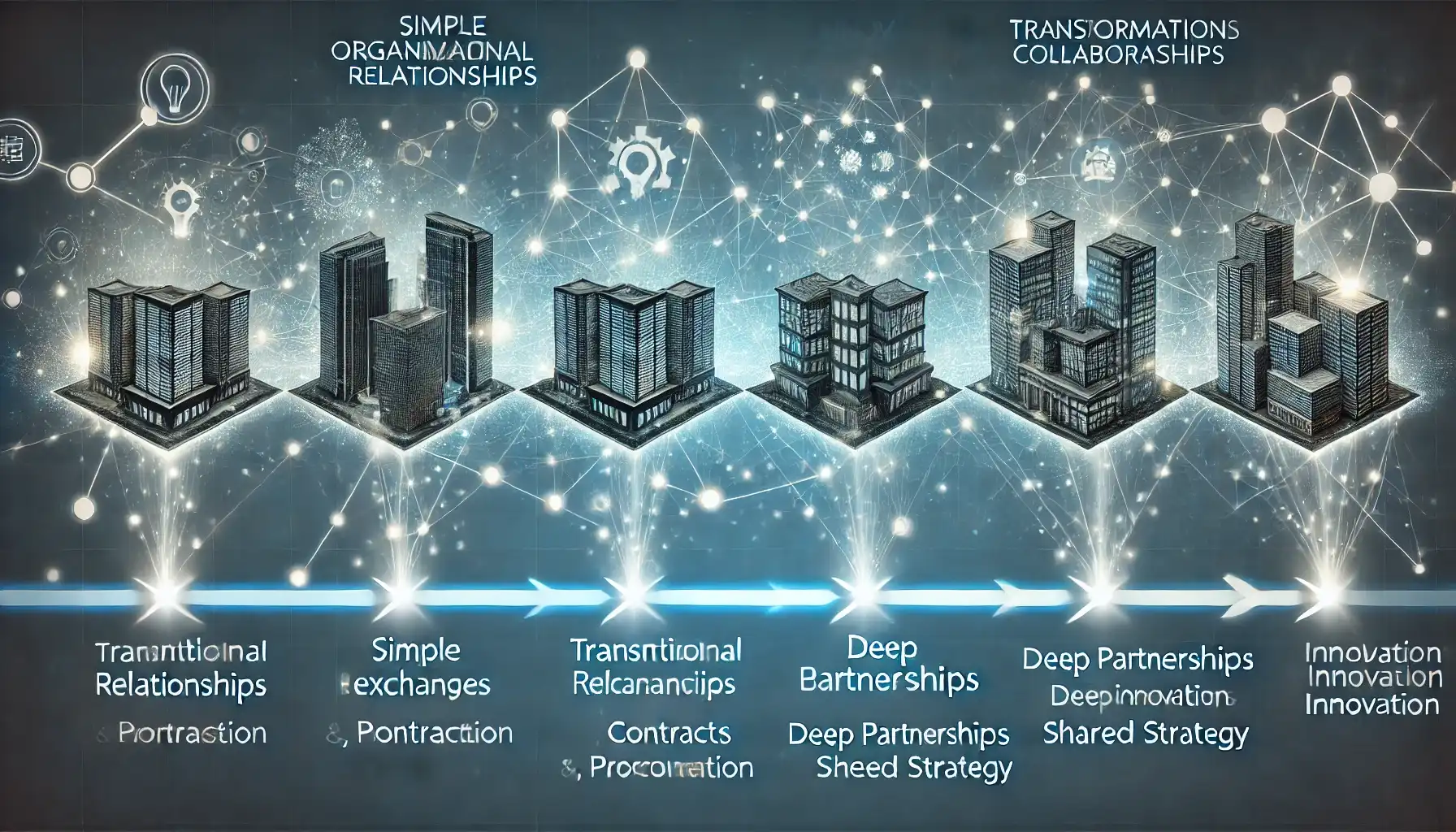
This post concludes our three-part series "The Architecture of Organizational Partnerships." In our first post, we explored the continuum of inter-organizational relationships from transactional exchanges to transformational collaborations. Our second post examined the critical infrastructure supporting successful partnerships. Now, we focus on the communication systems that serve as the nervous system of collaborative relationships, enabling everything from basic coordination to transformative innovation across organizational boundaries.
Introduction: The Essential Role of Communication in Building Strong Partnerships
Imagine two organizations attempting to collaborate without communicating. The scenario is absurd because we instinctively understand that without information flow, no partnership can function—let alone flourish. Communication isn't merely one aspect of inter-organizational relationships; it's the medium through which all other aspects exist.
Yet the communication challenges in cross-organizational contexts are profound. Information must traverse not just physical distance but boundaries of culture, technology, process, and sometimes even language. Messages cross hierarchical levels, functional specialties, and professional disciplines. Context gets stripped away, meaning becomes distorted, and alignment fragments.
In this final post, we'll explore the unique communication dynamics of inter-organizational relationships. We'll examine the synchronous-asynchronous spectrum, analyze today's communication tools landscape, unpack specific cross-boundary challenges, and build a case for more sophisticated approaches. As organizational partnerships become increasingly central to competitive advantage, mastering these communication systems emerges as a critical capability for twenty-first century enterprises.
The Synchronous-Asynchronous Spectrum: Finding the Right Rhythm
Communication between organizations occurs across a spectrum from deeply synchronous to fully asynchronous. Each approach offers distinct advantages and limitations, with the optimal mix depending on partnership type, task characteristics, and relationship stage.
Synchronous Communication: The Power of Real-Time Interaction
Synchronous communication—where participants exchange information simultaneously—creates immediacy, enables rapid feedback, and builds social presence. In partnership contexts, synchronous channels include:
In-person meetings remain unmatched for building trust, resolving complex conflicts, and making high-stakes decisions. A pharmaceutical company and biotech partner might hold quarterly face-to-face governance meetings where executive teams review progress and address strategic challenges.
Video conferences provide visual cues that help bridge organizational cultures while eliminating travel time. An automotive manufacturer collaborating with a software company on connected vehicle technology might hold weekly video standups between engineering teams.
Phone calls offer accessibility and conversational flow without visual distractions. Account managers from a telecommunications provider might conduct monthly service reviews with enterprise clients, covering performance metrics and addressing concerns.
Real-time messaging enables quick questions and immediate coordination. Project team members from a construction firm and its architectural partner might use chat platforms for time-sensitive clarifications on building specifications.
The strengths of synchronous communication in partnerships include:
- Builds interpersonal trust through social presence
- Enables nuanced interpretation through non-verbal cues
- Facilitates complex problem-solving through interactive dialogue
- Allows immediate clarification of misunderstandings
- Creates shared experiences binding partnerships together
However, synchronous approaches also present significant challenges:
- Requires scheduling across organizational calendars
- Produces limited documentation for future reference
- Fast-moving chat conversations do not maintain a structured history, making it hard to track the evolution of complex projects.
- Consumes substantial time from key stakeholders
Asynchronous Communication: The Power of Reflection and Documentation
Asynchronous communication—where information is sent and received at different times—offers thoughtfulness, inclusivity, and persistence. Key asynchronous channels in partnerships include:
Email remains the backbone of formal partnership communication. A technology vendor might send detailed specifications to a client organization, allowing recipients to review information at their convenience and distribute internally as needed.
Documentation repositories provide authoritative reference points. A manufacturing joint venture might maintain shared quality standards in a central document management system accessible to both parent companies.
Discussion forums enable threaded conversations around specific topics. Engineers from partnering aerospace companies might maintain technical discussions around interface specifications in structured forums organized by subsystem.
The strengths of asynchronous communication include:
- Creates permanent records reducing information loss
- Enables thoughtful, considered responses
- Accommodates different work schedules and time zones
- Scales more efficiently to include multiple stakeholders
Yet asynchronous approaches bring their own limitations:
- Lacks immediacy for urgent matters
- Creates potential for misinterpretation without contextual cues
- Can spawn lengthy, fragmented discussion threads
- May delay decisions requiring multiple exchanges
The Current Communication Tools Landscape
Today's inter-organizational relationships rely on an increasingly complex ecosystem of digital tools. Understanding this landscape—and its limitations—is essential for designing effective partnership communication.
Email: The Persistent Foundation
Despite predictions of its demise, email remains the foundational communication tool for most partnerships. This is primarily because there is no dedicated tool designed for structured, asynchronous, and trackable communication with external partners. The universal compatibility of email across organizations makes it the default channel for formal exchanges, documentation sharing, and relationship maintenance.
Yet email's limitations in partnership contexts are severe:
- Creates information silos accessible only to direct recipients
- Fragments conversations across multiple threads
- Provides poor visibility into organizational knowledge
- Lacks contextual organization around projects or topics
- Offers minimal integration with other systems
Nevertheless, email persists because it crosses organizational boundaries more seamlessly than any alternative.
Collaboration Platforms: Islands of Integration
To address some of these email challenges, group messaging platforms like Slack and Microsoft Teams emerged. These platforms organize messages into channels, ensuring discussions stay within relevant topics, and promote real-time collaboration. These platforms excel at integrating multiple communication modes (chat, video, file sharing) in context-rich environments. Their popularity surged, particularly for internal team communication. However, while real-time interaction is excellent for quick updates, these platforms lack structured, goal-oriented communication due to the following factors:
- Messages disappear quickly, making follow-ups on older messages difficult.
- External business collaboration often involves structured, slower-paced interactions due to varying response times among stakeholders.
- Fast-moving chat conversations do not maintain a structured history, making it hard to track the evolution of complex projects.
Virtual Meeting Platforms: The Synchronous Bridge
Video conferencing tools like Zoom, Microsoft Teams, and Webex have become the primary synchronous bridge between organizations. These platforms provide virtual meeting spaces independent of either organization's internal systems. Yet these tools still present challenges in partnership contexts:
- Offer minimal persistent context between meetings
- Struggle to facilitate complex collaborative activities
- Provide limited integration with asynchronous workflows
- Generate few useful artifacts beyond basic recordings
Despite these limitations, virtual meeting platforms have become essential infrastructure for partnership communication. A global semiconductor alliance might conduct hundreds of engineering coordination meetings monthly across multiple time zones, relying entirely on these tools to maintain technical alignment.
Unique Challenges in Cross-Organizational Communications
Beyond the synchronous-asynchronous spectrum and the limitations of current tools, partnership communication faces unique challenges stemming from the nature of inter-organizational boundaries. These challenges intensify as relationships move from transactional to transformational.
Context Continuity: The Broken Thread
Perhaps the most pervasive challenge in partnership communication is maintaining context continuity—ensuring information, decisions, and rationale remain connected across time, participants, and organizational boundaries.
Consider a strategic alliance between a telecommunications provider and equipment manufacturer. Their collaboration involves hundreds of participants across multiple functions and hierarchical levels. When a technical decision made in January affects a market launch in June, the context often fragments:
- Decision rationale gets lost in email threads or meeting minutes
- New stakeholders join without historical understanding
- Information exists in disconnected systems inaccessible across boundaries
- Context-restoring conversations happen in informal channels
This context discontinuity generates significant costs: duplicated work, reopened decisions, and misaligned expectations. Organizations try to mitigate these costs through detailed documentation, dedicated relationship managers, and regular review meetings, but these approaches scale poorly as partnerships grow more complex.
Knowledge Sharing and Documentation
Effective partnerships require appropriate knowledge sharing while protecting intellectual property and competitive information. This balance presents significant communication challenges:
Selective transparency – Determining what information should be shared versus withheld requires continuous judgment across organizational boundaries. In an automotive supplier relationship, detailed cost structures might remain protected while quality metrics are fully transparent.
Knowledge accessibility – Information properly shared often remains practically inaccessible due to different systems, taxonomies, or search capabilities. An aerospace partnership might share technical specifications that partner engineers cannot effectively discover or utilize.
Tacit knowledge transfer – Critical expertise often resides in people rather than documents but transferring this knowledge across organizational boundaries proves challenging.
These challenges create particular friction during partnership transitions—when new team members join, when relationship stages evolve, or when unexpected disruptions occur.
Security and Information Access Control
Security requirements frequently conflict with collaboration needs in partnership contexts. Organizations must protect sensitive information while enabling appropriate access for legitimate collaboration. This tension manifests in several ways:
Authentication complexity – Partners must navigate multiple security systems with different credentials, multi-factor requirements, and session limitations. A consulting firm working with multiple financial institutions might juggle dozens of security credentials across client environments.
Access granularity limitations – Security systems often provide insufficient granularity for partnership needs, forcing choices between oversharing and under-sharing. A pharmaceutical partnership might need molecule-specific access controls that existing systems cannot accommodate.
Shadow IT proliferation – When official channels create excessive friction, users often resort to unauthorized tools, increasing security risks. Team members frustrated by secure file transfer limitations might use personal cloud storage, creating compliance violations.
Cultural Barriers
Partnerships frequently span cultural and linguistic boundaries, creating communication challenges beyond mere translation. These challenges include:
Communication style differences – Cultural variations in directness, formality, and conflict handling affect message interpretation. A Nordic-Japanese partnership might experience misunderstandings when direct feedback meets cultural preferences for indirect communication.
Decision process expectations – Cultural assumptions about decision authority and consensus requirements lead to misaligned expectations. A German engineering firm might expect clear decision hierarchies while collaborating with a Swedish partner preferring consensus approaches.
Terminology differences – Even within the same language, organizations develop different terminology for similar concepts. A healthcare system and insurance partner might use different terms for identical patient care scenarios, creating persistent confusion.
These cultural and linguistic challenges affect both synchronous and asynchronous communication, though they manifest differently in each context.
The Case for Hybrid Communication Approaches
The limitations of current tools and the unique challenges of cross-organizational communication point toward the need for more sophisticated, hybrid approaches. The most effective partnerships are developing communication systems that:
1. Integrate Synchronous and Asynchronous Elements
A hybrid communication platform would allow conversations to naturally flow between synchronous and asynchronous modes based on the context and urgency. When discussion about product specifications need to transition into a real-time problem-solving session, the switch is seamless, maintaining all context and previous discussion history.
The system would support different interaction patterns without forcing users into a single mode or communication. This means maintaining the efficiency of real-time chat when needed while providing structured, threaded discussions for longer term conversations and decision-making processes.
2. Maintain Context Continuity
The platform systems preserve context across time, participants, and organizational boundaries,maintaining complete conversation context regardless of the time between responses. Whether team members are engaging in real-time discussions or responding days later, the full context of the conversation - including all decisions, documents and discussion threads - will remain easily accessible and comprehensible.
Conversation threading connects related discussions across within a topic or channel, preventing fragmentation.
Accessible archives make historical information discoverable when needed for current decisions, without overwhelming active discussions.
3. Balance Security with Accessibility
Advanced partnership communication reconciles seemingly conflicting needs for security and collaboration:
Secure Spaces provide secure workspaces shared by partner organizations. Such workspaces enable security transparency by helping partners understand protection and access control without creating anxiety about information handling.
Granular permissions provide access precisely matched to collaboration requirements without over-exposure.
Contextual security applies different controls based on content type, user role, and relationship stage rather than one-size-fits-all policies.
Frictionless compliance makes secure practices easier than unsecured alternatives, preventing shadow IT proliferation.
4. Bridge Cultural and Linguistic Divides
Effective cross-boundary communication systems actively address cultural and linguistic challenges:
Translation augmentation provides real-time language support without disrupting natural conversation flow.
Cultural context additions help interpret messages according to originator context rather than recipient assumptions.
Terminology alignment tools create shared understanding of key concepts across organizational vocabularies.
Conclusion
As we've explored throughout this series, organizational boundaries are becoming increasingly porous. Success in today's interconnected landscape frequently depends on forming and maintaining effective external relationships—from simple transactional exchanges to transformative strategic collaborations.
The communication systems connecting these relationships function as their nervous system, enabling everything from basic coordination to breakthrough innovation. Organizations that master cross-boundary communication gain significant advantages: reduced coordination costs, faster decision cycles, more effective knowledge transfer, and greater partnership stability.
This capability becomes particularly critical as relationships move up the continuum from transactional to transformational. While simple exchanges can function with basic communication tools, strategic alliances and transformational collaborations require sophisticated approaches integrating synchronous and asynchronous elements, maintaining context continuity, balancing security with accessibility, and bridging cultural divides.
The organizations leading their industries in the coming decade will be those that recognize partnership communication as a strategic capability demanding deliberate design, appropriate technology, and developed organizational skills. They will create communication fabrics that weave their external relationships into sources of sustainable competitive advantage—connecting across boundaries that their competitors cannot bridge.
This concludes our three-part series on "The Architecture of Organizational Partnerships." We've explored the relationship continuum, examined the infrastructure supporting successful collaborations, and now unpacked the communication systems that bind partnerships together. We hope these insights help your organization build more effective, valuable external relationships in an increasingly interconnected world.
Further Reading
-
Synchronous and asynchronous communication: differences, advantages, and disadvantages
-
Slack vs Email: Which Communication Tool is Best for Your Team?
-
Asynchronous or Synchronous Collaboration? The Expert Low Down On What's Best For You
-
Access Controls in Google Workspace: Master Role-Based Security