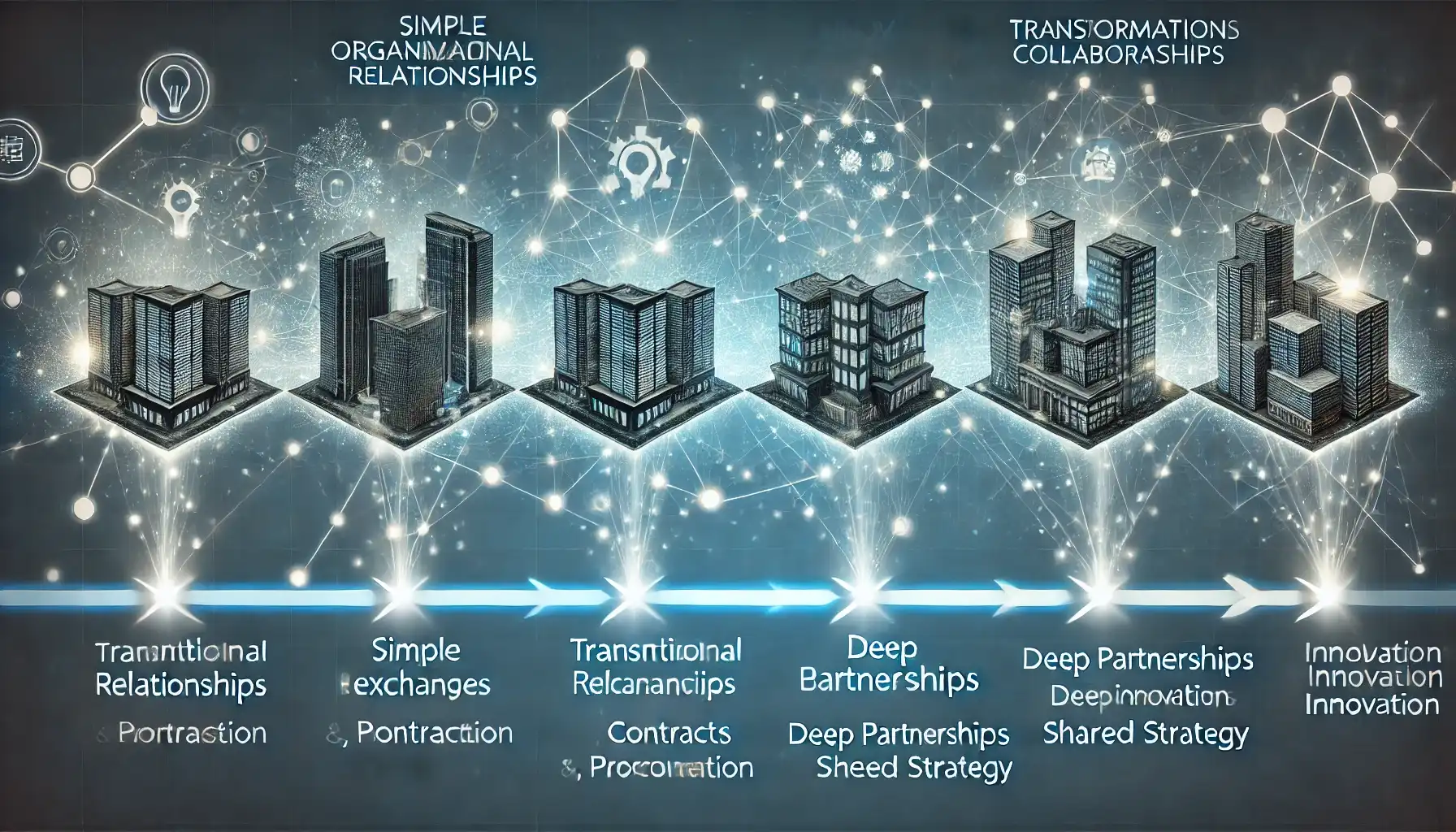
This post is the second in our three-part series "The Architecture of Organizational Partnerships." In our first post, we mapped the continuum of inter-organizational relationships from transactional exchanges to transformational collaborations. Now, we'll examine the critical infrastructure that supports successful partnerships, before concluding with an exploration of communication systems in our final installment. Join us as we uncover the hidden architecture that makes collaborative relationships thrive in today's interconnected business landscape.
Introduction: The Hidden Architecture of Partnership Success
When we observe successful collaborations between organizations, we often see only their visible achievements: innovative products launched, markets expanded, or efficiencies gained. What remains hidden are the sophisticated systems and structures that make these outcomes possible—the underlying infrastructure that supports and sustains collaborative relationships.
Like a city's invisible utilities running beneath its streets, this collaborative infrastructure determines whether partnerships flourish or fail. The most promising strategic alliances can collapse without proper foundations, while seemingly modest partnerships can create extraordinary value when built upon solid collaborative systems.
This post explores the critical components of this infrastructure—the sociological, economic, governance, and performance management dimensions that shape inter-organizational relationships. And as we'll discover, communication emerges as the essential element binding these components together, creating a cohesive system capable of generating mutual value.
The Sociological Dimension: Building Trust and Shared Identity
At the heart of every successful collaboration lies a web of human relationships. The sociological dimension encompasses the cultural, interpersonal, and identity elements that determine how organizations interact and whether they can truly work together effectively.
Trust: The Foundation of Collaboration
Trust functions as the bedrock upon which all meaningful partnerships are built. In the context of inter-organizational relationships, trust manifests in three critical forms:
Competence trust reflects confidence in a partner's ability to deliver on promises and execute responsibilities effectively. A pharmaceutical company partnering with a contract research organization needs assurance that the CRO possesses the technical capabilities and expertise to conduct clinical trials properly.
Contractual trust involves belief that a partner will adhere to agreements, both formal and informal. When a technology company licenses its software to another firm, it trusts the licensee will use the software only as stipulated and protect intellectual property appropriately.
Goodwill trust—the most advanced form—represents faith that a partner will act in the relationship's best interest, sometimes even at the expense of immediate self-interest. Strategic alliances between automotive manufacturers and autonomous driving technology firms often require this level of trust, as both parties must make decisions benefiting their joint future rather than maximizing short-term gains.
Trust development follows a predictable pattern in successful partnerships:
- Initial assessment based on reputation, references, and initial interactions
- Verification through small, successful exchanges with manageable risk
- Reinforcement via consistent performance and transparent communication
- Expansion to include more consequential activities and outcomes
- Institutionalization where trust moves beyond individual relationships to exist between the organizations themselves
Cultural Alignment: Finding Harmony in Difference
Organizations develop distinct cultures encompassing values, norms, decision-making approaches, and working styles. These cultural fingerprints significantly impact collaboration success. Research shows that partnerships between organizations with complementary cultures outperform those with clashing cultural orientations.
Key cultural dimensions affecting partnership dynamics include:
- Risk tolerance – How partners evaluate and respond to uncertainty
- Time orientation – Focus on short-term results versus long-term development
- Formality – Preference for structured processes versus flexible approaches
- Decision-making style – Top-down versus consensual approaches
- Communication norms – Direct versus indirect, formal versus casual
- Innovation approach – Incremental improvement versus disruptive change
Cultural alignment doesn't require identical cultures—indeed, complementary differences often drive partnership value. What matters is awareness of differences and developing bridges between divergent approaches. Successful collaborators conduct cultural due diligence before partnership formation and create deliberate mechanisms to navigate differences throughout the relationship.
The Economic Foundation: Creating and Capturing Value Together
Beneath the sociological dimension lies the economic foundation of partnership—the mechanisms through which organizations create, distribute, and capture value together. Without sustainable economics, even the most trusting relationships eventually deteriorate.
Value Creation: The Partnership Dividend
The fundamental economic rationale for partnership is value creation—generating benefits impossible or inefficient to achieve independently. This "partnership dividend" comes from several sources:
Complementary capabilities combine to create value exceeding the sum of parts. When a pharmaceutical company with drug discovery expertise partners with a biotechnology firm possessing novel delivery technology, they can develop therapeutic approaches neither could create alone.
Scale advantages emerge when partners pool resources to achieve efficiencies unavailable to smaller operations. Competing telecommunications providers often share infrastructure investments, allowing each to offer broader coverage while reducing capital expenditure.
Risk sharing distributes uncertainty across multiple entities, enabling initiatives too risky for a single organization to undertake. Consortia of energy companies often jointly develop experimental technologies, sharing both potential rewards and possible failures.
Network effects multiply as partnerships expand access to customers, suppliers, or complementary offerings. Software companies partner with systems integrators to reach enterprise customers, while integrators gain valuable offerings for their portfolios.
Knowledge exchange creates value as organizations learn from each other's expertise, processes, or market insights. Automotive manufacturers frequently partner with tech companies partly to absorb digital capabilities that would take years to develop internally.
Resource Allocation and Investment
Successful partnerships require intentional allocation of resources—financial, human, technological, and attentional. The investment approach must balance several considerations:
Proportionality – Do investments reflect the expected benefits for each partner? Timing – Are investments synchronized to prevent bottlenecks or wasted resources? Specificity – Are investments tailored to partnership needs rather than generic? Recoverability – What happens to investments if the partnership dissolves?
Organizations often struggle with these questions, particularly when partnerships require significant partner-specific investments. A manufacturing joint venture might require both organizations to acquire specialized equipment usable only for joint production. Such relationship-specific investments increase both potential returns and risks.
Game Theory in Practice: Aligning Incentives
Partnership economics fundamentally involve managing incentives across organizational boundaries. Game theory provides valuable insights into how partners can align interests to prevent value destruction through opportunistic behavior.
The prisoner's dilemma—where rational self-interest leads to suboptimal outcomes for both parties—frequently manifests in partnerships. Consider a technology alliance where both companies should contribute proprietary knowledge but each has incentive to withhold their best insights while absorbing the partner's expertise.
Successful partnerships overcome these dynamics through mechanisms that:
- Create repeated interactions with long-term horizons
- Ensure transparent observation of partner behavior
- Establish credible consequences for non-cooperation
- Develop mutual hostages through balanced investments
- Align rewards with collective rather than individual performance
The semiconductor industry provides an illustrative example. TSMC and Apple have developed a partnership where Apple designs cutting-edge chips and TSMC manufactures them. The arrangement works because Apple commits to massive production volumes, while TSMC dedicates significant capacity and development resources to Apple's needs. Both make partner-specific investments that create mutual dependency, aligning incentives for cooperation.
Governance Structures: Designing Decision Architecture
If economics provides the "why" of partnership, governance supplies the "how"—the formal and informal structures determining decision rights, accountability mechanisms, and conflict resolution approaches that guide collaborative activities.
Decision Rights: Who Decides What and How
Every partnership must determine where decision authority resides for different matters. Effective governance distributes decision rights based on:
Expertise – Which partner possesses greater knowledge relevant to the decision? Resources – Which partner contributes more to implementing the decision? Risk exposure – Which partner bears more risk from the decision outcome? Strategic importance – How central is the decision to each partner's core interests?
Decision rights typically fall into several patterns:
Independent decision-making where each partner maintains complete authority in designated domains Consultative decision-making where one partner decides but must seek input from the other Consensus decision-making requiring agreement from both partners before proceeding Delegated decision-making transferring authority to joint teams or designated individuals
The pharmaceutical industry demonstrates these patterns in R&D alliances. A typical biotech-pharma partnership might give the biotech company primary decision authority on early research questions, implement consensus decision-making for development strategy, and delegate commercialization decisions to the pharmaceutical partner—aligning decision rights with respective expertise.
Accountability Mechanisms: Ensuring Performance
Partnerships require mechanisms ensuring both organizations fulfill their commitments. These accountability structures become increasingly important as relationships move up the continuum from transactional to transformational.
Effective accountability systems include:
Clear performance expectations documented and understood by both parties Regular review processes assessing progress against commitments Escalation pathways for addressing performance concerns Consequences for consistently unmet obligations Balanced oversight preventing one partner from disproportionate monitoring burden
The aerospace industry exemplifies sophisticated accountability mechanisms in its supplier partnerships. When Boeing develops a new aircraft, it establishes tiered review processes with strategic suppliers, from weekly technical assessments to quarterly executive reviews, ensuring alignment across complex, multi-year development cycles.
Conflict Resolution: Managing Inevitable Tensions
Even the best-designed partnerships experience conflicts. What distinguishes successful collaborations is not the absence of conflict but the presence of effective resolution mechanisms.
Partners should establish:
Early warning systems to identify potential conflicts before escalation Graduated resolution processes starting with operational-level resolution before involving senior leadership Neutral facilitation options for particularly contentious issues Predetermined principles to guide resolution of specific conflict types Exit procedures determining how partners can dissolve the relationship if necessary
A notable example comes from the retail-technology sector. Walmart and Microsoft's cloud partnership includes a multi-tiered governance structure with designated "partnership managers" who meet on a regular basis to address emerging issues, escalation paths to executive sponsors for unresolved conflicts, and annual strategic reviews that proactively identify potential future tensions.
Performance Management: Measuring Collaborative Success
The adage "what gets measured gets managed" applies powerfully to partnerships. Performance management systems define how partners evaluate success, identify improvement opportunities, and adapt to changing circumstances.
Metrics: Measuring What Matters
Partnership metrics should capture both tangible outcomes and relationship health indicators. Comprehensive measurement frameworks include:
Financial metrics – Revenue generated, costs saved, margins improved Operational metrics – Cycle times, quality indicators, delivery performance Innovation metrics – New products developed, patents filed, knowledge transferred Market metrics – Customer acquisition, market share, competitive positioning Relationship metrics – Trust levels, conflict frequency, satisfaction with collaboration
The manufacturing sector demonstrates sophisticated partnership metrics in automotive supplier relationships. Beyond traditional quality and delivery KPIs, companies like Toyota implement supplier development metrics tracking capability improvements, innovation contributions, and collaborative problem-solving effectiveness.
Feedback Loops: Learning and Adaptation
Measurement creates value only when connected to action. Effective partnerships establish structured feedback loops converting performance data into improvement:
Regular review cadences – Daily, weekly, monthly, and quarterly rhythms matching decision needs Multi-level participation – Operational and strategic perspectives included Fact-based discussions – Data-driven analysis rather than perception-based assessment Joint problem-solving – Collaborative approach to addressing performance gaps Continuous improvement mechanisms – Systematic processes for implementing change
The technology sector exemplifies these principles in cloud service partnerships. Companies like AWS and their strategic partners implement automated performance dashboards, regular service reviews, and joint architecture review boards that continuously evaluate and enhance their collaborative offerings.
Communication: The Binding Element
Throughout our exploration of partnership infrastructure, one element consistently emerges as critical across all dimensions: communication. Like the nervous system connecting components of a living organism, communication integrates the sociological, economic, governance, and performance aspects of collaboration into a cohesive whole.
Effective partnership communication:
Builds trust through transparency, consistency, and appropriate information sharing
Bridges cultural differences by creating shared understanding and expectations
Reinforces shared identity through narrative and collective meaning-making
Facilitates economic alignment by clarifying value creation and distribution
Enables governance through clear decision processes and conflict resolution
Powers performance improvement via feedback and adaptation
The unique challenges of communication across organizational boundaries—and the increasingly sophisticated tools available to address these challenges—merit dedicated exploration. In our final post of this series, we'll examine how communication functions as both the glue holding partnerships together and the oil keeping collaborative machinery running smoothly.
Conclusion: Building the Foundation for Collaborative Success
As we've seen, successful inter-organizational relationships rest upon sophisticated infrastructure spanning multiple dimensions. The sociological foundation of trust, cultural alignment, and shared identity creates the human connections essential for collaboration. Economic mechanisms ensure sustainable value creation and aligned incentives. Governance structures provide the decision architecture guiding joint activities. Performance management systems drive continuous improvement and adaptation.
Organizations that deliberately design and maintain this infrastructure dramatically increase their chances of partnership success. Those that neglect these foundations often find their collaborative aspirations frustrated, despite the best intentions and significant investments.
In today's increasingly interconnected business landscape, the ability to build and manage this collaborative infrastructure represents a distinctive organizational capability—one that separates leaders from followers in nearly every industry. As traditional organizational boundaries continue to blur, mastering the architecture of partnership becomes not just advantageous but essential.
In our final post of this series, we'll explore how communication systems function as the nervous system of inter-organizational relationships, examining the unique challenges of cross-boundary information sharing and the evolving tools addressing these challenges.