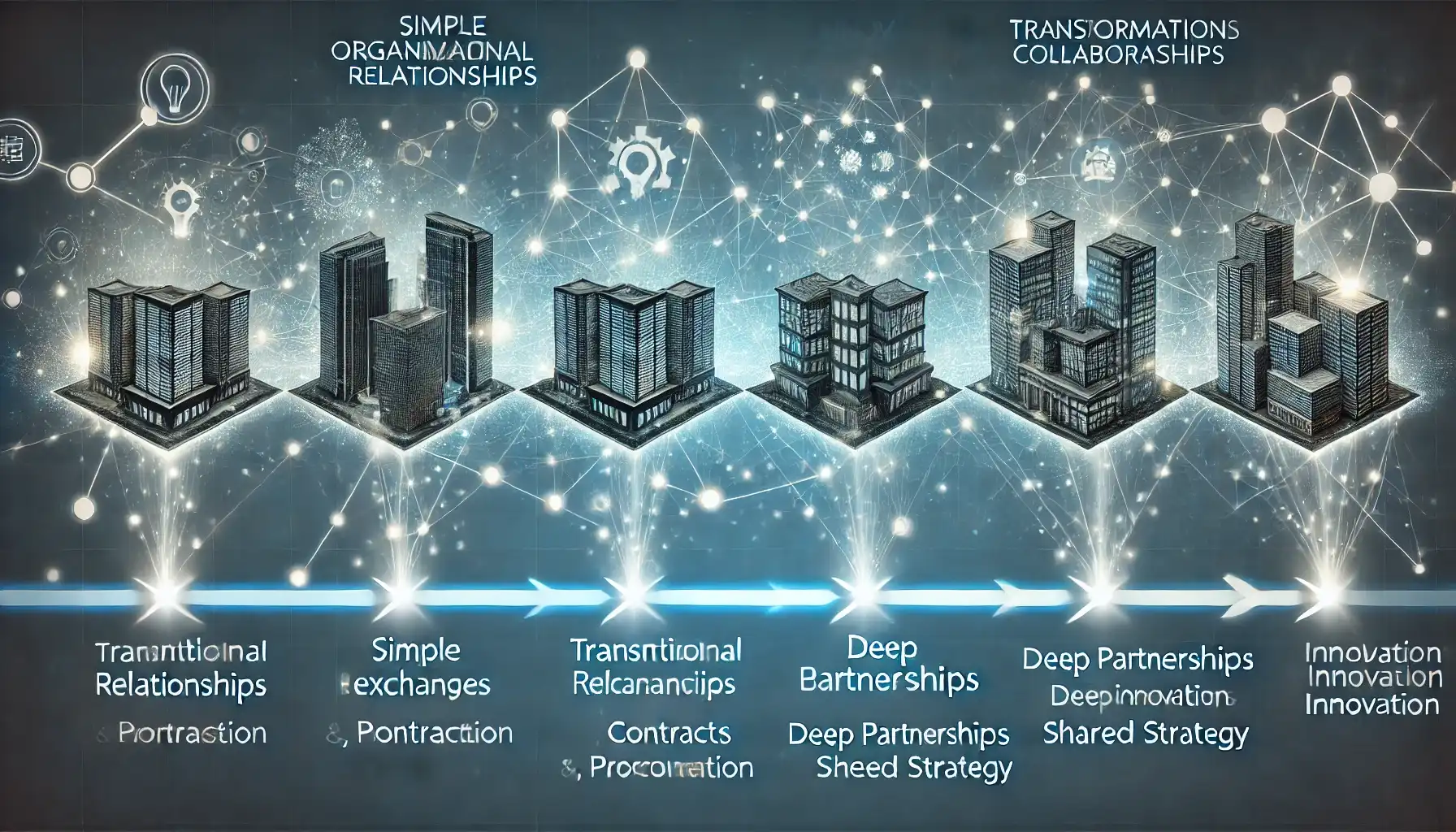
This post is the first in our three-part series "The Architecture of Organizational Partnerships." In this series, we explore how organizations build and maintain external relationships, from simple transactions to complex strategic alliances. After establishing the relationship continuum in this post, we'll examine the underlying foundations of successful collaborations in part two, and conclude with an in-depth look at the critical role of communication systems in part three. Join us as we unpack the evolving nature of inter-organizational partnerships in today's interconnected business landscape.
Introduction: The Dissolving Boundaries of Modern Business
In the world of business, enterprises rarely operate in isolation. Their success hinges on a web of relationships with external partners - vendors, suppliers, distributors, and collaborators - each connection pulsing with its own rhythm and purpose. These relationships stretch across a continuum, from fleeting exchanges to deep, interwoven partnerships that shape industries and markets. As organizational boundaries become increasingly porous, understanding how these relationships form, evolve, and create value has never been more critical.
Today's competitive landscape demands that organizations master the art of external engagement. Whether sourcing materials, outsourcing functions, or co-creating innovative solutions, the quality of inter-organizational relationships often determines which companies thrive and which struggle to adapt. This first post maps the terrain of these vital connections, offering a framework for understanding how organizations relate to one another in an increasingly networked world.
The Relationship Continuum: From Transactions to Transformations
External relationships between organizations exist along a spectrum of integration, commitment, and strategic importance. Let's explore this continuum, from the most basic interactions to the most sophisticated partnerships:
Transactional Relationships: The Fleeting Handshake
Picture a small tech startup outfitting its new office. The team needs monitors, cables, and a few peripherals—nothing custom, just the essentials. They reach out to a vendor, place an order, and within days, the goods arrive. Payment is processed, a confirmation email exchanged, and the interaction ends. This is the essence of a transactional relationship: a brief, utilitarian exchange with no strings attached.
Enterprises encounter these moments daily—buying stationery, ordering disposable gloves for a hospital, or sourcing standard chemicals for a semiconductor fab. The relationship begins and ends with the transaction, leaving no footprint for the future.
Key characteristics:
- Discrete, routine exchanges
- Standardized products or services
- Price-driven decisions
- Limited information sharing
- Minimal investment in relationship-building
- Easily replaceable partners
Communication in this realm is sparse and to the point. It's the language of necessity: an order number, a delivery date, a tracking link. There is no need for pleasantries or strategic discussions - both parties know their roles and stick to the script. The conversation is a means to an end, efficient and unembellished.
Repeat Customer Relationships: Building Familiarity
As transactions recur, a different dynamic emerges. Imagine that startup growing. Monitors break, cables wear out, and soon they are back with the same vendor, placing orders month after month. What began as a one-off transaction evolves into something steadier - a repeat customer relationship.
There's no grand partnership here, no shared destiny, but a quiet familiarity takes root. The vendor learns the startup's preferences - perhaps a specific brand of monitor - and the startup trusts the supplier's reliability. Across industries, this pattern repeats: a telecom operator ordering spare parts from a maintenance firm, or a pharmaceutical company sourcing raw materials from a trusted provider.
Key characteristics:
- Recurring transactions over time
- Growing familiarity with preferences
- Modest efficiency gains through repetition
- Basic relationship history develops
- Some preference for continuity, but low switching costs
Communication in these relationships picks up a subtle warmth. It's still focused on the transaction - pricing, availability, and delivery - but there's room for a little more. The telecom operator might negotiate a discount for bulk orders, chatting briefly about future needs. These exchanges don't stray far from the operational, a nod to the consistency that binds the two parties over time.
Contractual Partnerships: Structured Collaboration
Moving further along the continuum, we encounter contractual partnerships, where a formal agreement lays out the steps for both sides. This isn't about one-off purchases or casual repeat business; it's a defined commitment tied to a project or service with a clear scope and timeline.
Picture a pharmaceutical giant outsourcing clinical trials to a contract research organization (CRO). The contract spells out milestones, deliverables, and payment schedules, bringing the two into a temporary but deliberate embrace. Or consider a telecom company leasing bandwidth from another provider, locked into a year-long deal with performance clauses.
Key characteristics:
- Formal agreements defining expectations
- Time-bound projects or service periods
- Clear performance metrics
- Regular reporting and reviews
- Moderate switching costs
- Defined processes for issue resolution
Here, communication takes on a rhythm dictated by the contract. Monthly status reports flow between the pharma company and the CRO, detailing trial progress and flagging delays. The telecom partners schedule performance reviews, dissecting bandwidth uptime and troubleshooting hiccups. These conversations are regular, purposeful, and tied to execution rather than inspiration—the language of accountability keeping both parties aligned.
Strategic Alliances: Shared Vision and Value
As we move deeper into integration, we encounter strategic alliances—relationships where both organizations recognize significant mutual benefit in closely aligning parts of their operations. These partnerships feature substantial resource commitments, shared objectives, and a medium to long-term horizon.
Consider an automotive manufacturer forming an alliance with a battery technology company to develop electric vehicles. Both bring complementary capabilities to the table: the automaker contributes manufacturing expertise and market access, while the battery company provides critical technology for the industry's electric future.
Key characteristics:
- Significant resource investment from both parties
- Complementary capabilities creating joint value
- Medium to long-term orientation
- Shared goals and metrics
- Executive sponsorship and oversight
- Formalized governance structures
- High switching costs
Communication in strategic alliances becomes multifaceted and multilayered. It's no longer just about execution but also about alignment, innovation, and mutual growth. Leadership teams meet quarterly to review progress and adjust direction. Project teams collaborate weekly on technical challenges. Dedicated alliance managers smooth day-to-day interactions. The dialogue extends beyond "what" and "when" to include "why" and "how"—reflecting the deeper interdependence between the organizations.
Transformational Collaborations: Co-Creating the Future
At the furthest end of our continuum lie transformational collaborations—partnerships of such depth and strategic importance that they fundamentally reshape the participating organizations and potentially their industries. These rare relationships feature deep integration, shared destiny, and the co-creation of new value that neither organization could achieve alone.
Imagine a healthcare provider and a tech company forming a joint venture to revolutionize remote patient monitoring. They combine clinical expertise with advanced sensor technology and AI to create solutions that transform care delivery models. Their collaboration might spawn new business units, intellectual property, or even industry standards.
Key characteristics:
- Deep operational integration
- Joint innovation and co-creation
- Shared long-term destiny
- Cultural alignment
- Transformative potential for both organizations
- Executive leadership deeply involved
- Comprehensive governance frameworks
- Extremely high switching costs
Communication in transformational collaborations becomes almost indistinguishable from internal organizational dialogue. It's continuous, transparent, and occurs at all levels—from strategic planning sessions with C-suite executives to daily problem-solving among operational teams. Trust allows for constructive conflict, rapid iteration, and true innovation. The conversation encompasses not just the partnership itself but the shared future both organizations are building together.
Case Studies: The Continuum in Action
Technology: From Cloud Customer to Platform Co-Creator
A midsize financial services firm initially subscribed to a major cloud provider's basic infrastructure services—a straightforward transactional relationship. As their needs grew, they became a repeat customer with a dedicated account team. Eventually, they entered a contractual partnership with service-level agreements and customized solutions.
The relationship evolved further when the financial firm's unique compliance requirements led to a strategic alliance developing specialized security features beneficial to both companies. Today, they operate a transformational collaboration where the financial firm serves as a co-development partner for new financial services features on the cloud platform, fundamentally reshaping both businesses.
Healthcare: Building a Connected Care Ecosystem
A regional hospital network began purchasing standard medical supplies from a healthcare products company—classic transactional exchanges. Recurring orders established a repeat customer relationship, which evolved into a contractual partnership when the supplier began managing inventory for multiple facilities.
Recognizing shared interests in improving patient outcomes, the organizations formed a strategic alliance to develop and implement remote monitoring solutions. This eventually blossomed into a transformational collaboration creating an integrated care ecosystem connecting patients, providers, and medical technology in novel ways that neither organization could have achieved independently.
Conclusion: The Strategic Imperative of Relationship Management
As we've seen, external relationships represent a spectrum of possibilities, each offering different levels of value, requiring different investments, and creating different strategic opportunities. Organizations that deliberately manage their portfolio of external relationships—understanding where each partnership sits on the continuum and how it might evolve—gain significant competitive advantage.
The relationship continuum provides a framework for this strategic approach. By evaluating current partnerships and deliberately developing those with the highest potential, organizations can unlock new capabilities, access complementary resources, and create value impossible to generate alone.
In our next post, we'll explore the underlying infrastructure that supports successful collaborative relationships—the economic, sociological, governance, and performance management systems that determine whether partnerships flourish or fail. And as we'll see, communication emerges as the critical binding element that makes these complex relationships work.
Further Reading
-
From Transactional into Relational: Forming Effective Customer Relationships
-
Contract Management KPIs - Contract Performance Metrics That Matter
-
The spectrum of inter-organizational relationships and social capital mobilization of MNEs
-
Collaborative inter-organisational relationships and management control change